Ever heard of robotics? Sounds very futuristic, but do you actually know what it is? Let’s explore.
In simple words, robotics engineering is all about incorporating multiple fields of study into building robotics systems. It helps organizations to evolve and become more profitable and efficient. The robotics field needs fully experienced professionals in electrical engineering, computer science, data analysis, and other areas.
In this blog, we will see how to become a Robotics Engineer, what degree is needed what career choices you have.
What is Robotics Engineering?
Robotics deals with building, operating, designing, and engineering robots and robotics systems, which is totally based on practical applications and theoretical understanding. Robotics engineering includes mechanical, electrical, and computer engineering; it’s a multidisciplinary field.
Here are the core responsibilities of robotics engineers
- Programming, developing, and designing robotics systems.
- Identify the area of improvement and evaluation of performance.
- For better functionality the the creation of operational algorithms.
- For compliance with standards, make sure to do rigorous testing.
Skills & Approach
- They have to work with different engineering technologies.
- It blends technical expertise, creativity, and problem-solving skills.
Applications of Robotics Engineering
- In the manufacturing industry, collaborative robots.
- Drones and autonomous vehicles.
- Cyber-physical humanoid machines.
What is a Robotics Software Engineer?
A robotics software engineer is a specialized software engineer who works directly with robotics systems. Robotics systems involve machines and manufacturing tools, military, plus medical equipment and vehicle robotics systems. The engineer helps design and write the code for the system that tells the hardware how to operate, given specific inputs.
Robotics Engineers Vs Robotics Software Engineers
Here is the detailed comparison table of what robotics engineers do and what robotics software engineers do
| Aspect | Robotics Engineer | Robotics Software Engineer |
| Primary Focus | Develops robotics applications for industries (aerospace, automotive, defense, manufacturing, healthcare, agriculture). | Develops, tests, and maintains software that controls robotic systems. |
| Designing | Conceptualizes robotic systems, creates blueprints, defines components, structure, and functionality. | Creates software design plans, mock-ups, project maps, and wireframes. |
| Building | Develops robots using electrical, mechanical, and computer engineering principles. Integrates actuators, controllers, sensors, and motors. | Builds software to control hardware, ensuring functionality, updates, and security. |
| Programming | Writes code (C++, Python, ROS) to control robot behavior, motion, and operations. | Writes and edits code (Python, C++, JavaScript, HTML) to define software functionality and integration with hardware. |
| Testing | Runs simulations and tests robots for safety, performance, and reliability; troubleshoots hardware/software issues. | Tests software-hardware compatibility; collaborates with professionals (e.g., surgeons for medical robotics) to validate performance. |
| Operation & Maintenance | Diagnoses issues, replace components, and implement modifications throughout a robot’s lifecycle. | Provides software updates, bug fixes, and helps customers understand software use and costs. |
| Documentation | Less focused on documentation; more on physical building and maintenance. | Writes software manuals, progress reports, patents, and technical documents. |
| Collaboration | Works closely with cross-disciplinary engineers (mechanical, electrical, and computer). | Works closely with software teams, hardware engineers, designers, and customers for smooth integration. |
| Industry Contribution | Brings hardware to life through engineering, ensuring physical systems function. | Provides the intelligence layer (software) that makes hardware usable and adaptable. |
Similarities Between Robotics Engineers and Robotics Software Engineers
| Similarity Area | Description |
| Problem-Solving | Both roles focus on solving complex engineering challenges to ensure robots function effectively. |
| Programming Knowledge | Both require strong coding skills (e.g., Python, C++) to control robotic behavior and performance. |
| Testing | Both conduct rigorous testing—whether hardware, software, or combined systems—to ensure safety, reliability, and compliance. |
| Collaboration | Both work with cross-functional teams (engineers, designers, and customers) to integrate hardware and software. |
| Continuous Improvement | Both are involved in troubleshooting, updates, and optimizations throughout a robot’s lifecycle. |
| Documentation | Both create technical records (logs, reports, or manuals) to track progress and guide future improvements. |
| Innovation-Driven | Both contribute to advancing robotics technology across industries such as healthcare, automotive, aerospace, and manufacturing. |
How to Become a Robotics Engineer?
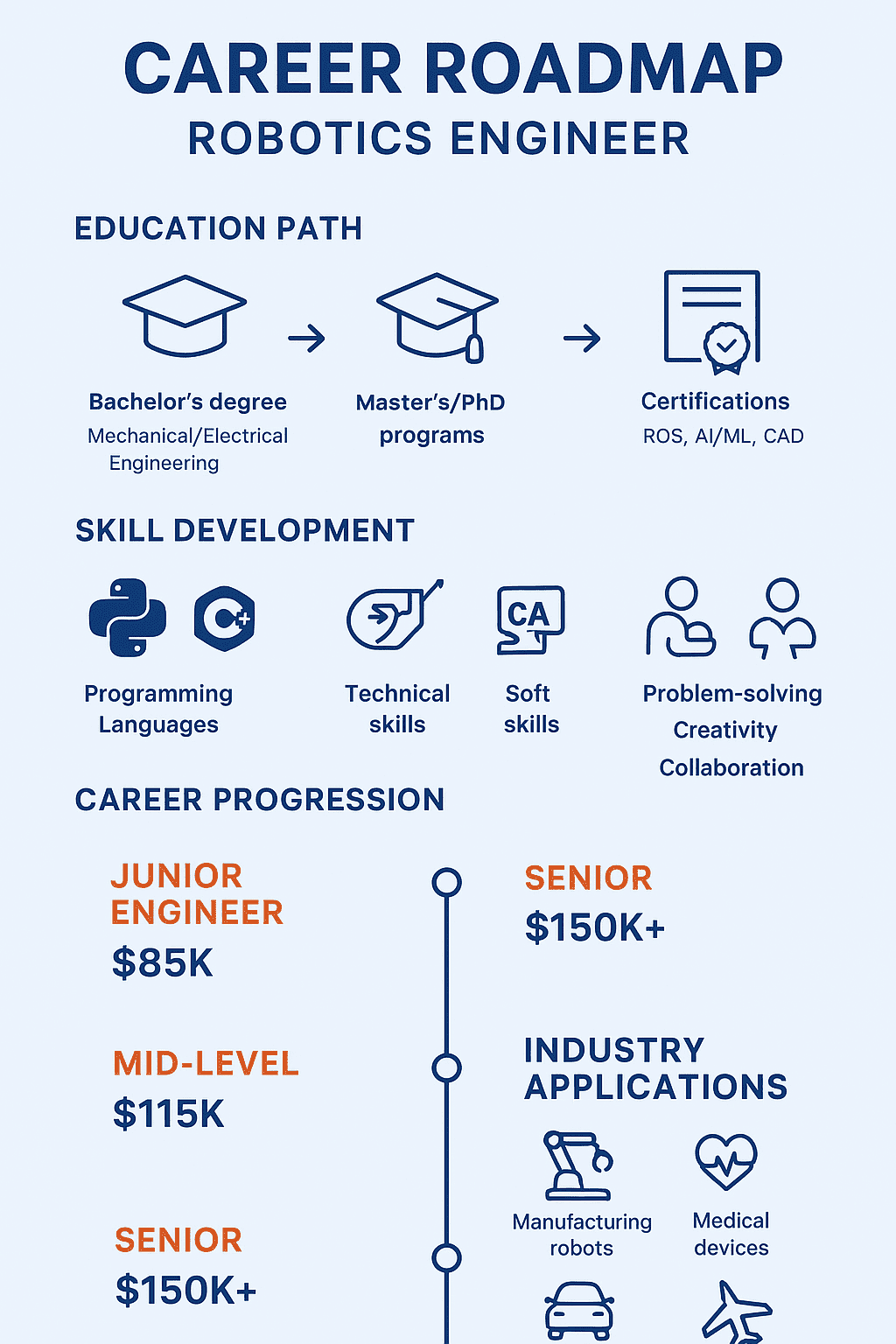
You will need a bachelor’s degree in order to become a robotics engineer. If you have intentions of working as a robotics software engineer, then you definitely need a background in computer science. In the same way, if you want to design robotics components, you need to study electrical or mechanical engineering.
Get a Bachelor’s Degree
Different universities offer a bachelor’s degree in various types of robotics engineering. Many robotics engineers like to pursue an electrical or mechanical degree with more focus on robotics.
You have the option to choose from different majors and still continue your robotics career, which includes
- Electrical Engineering
- Mechanical Engineering
- Computer Sciences
- Math
- Design and Technology
- Computing and Programming
Get Experience
It is a very common practice to hire experienced candidates, but there are a few companies that hire freshers or newly graduated students. To gain experience, you can do an internship or volunteer to work on different projects in the university or at robotics labs.
You can also look out for internships that are paid with companies that make and sell robots. Internships are very helpful; you can learn a lot of new things, and your mentor can guide you to start your career.
Consider a Graduate Degree
Mostly, companies give preference to the applicants who have completed master’s or doctoral degree programs in robotics engineering while hiring. Graduation programs give you the opportunity to gain more knowledge and skills via advanced coursework and research opportunities. Commonly master’s degree is completed in two years, and a doctoral degree can take four to eight years.
Licensure or Certifications
To get licensure, you don’t need to study robotics engineering. But if you want to improve your job prospects, you might need to earn professional credentials. After the completion of the necessary theoretical and practical training requirements, engineers can earn their professional engineer designation.
Which Skills are Needed for Robotics Engineers?
Job descriptions can be different for different types of robotics roles, but still, there are common skills that are required in the robotics field, which every professional should adopt:
Proficiency in Programming
It’s mandatory for robotics engineers to be proficient in different programming languages like C++, MATLAB, and Python. These languages are important in order to control development algorithms and robots.
Physics & Maths Knowledge
For proper designing of robotics systems, a strong foundation is required in maths (especially in linear algebra and calculus) and physics (electromagnetism and mechanics).
Expertise in Mechanical Design
For the creation of robots that function effectively, it is important to understand the critical mechanical design principles. A basic familiarity with CAD (Computer-Aided Design) tools can also be invaluable.
Thinking Creatively
In the profession of robotics, creative thinking can go a long way. It can also help boost your business development and marketing skills. Creativity and teamwork can be very handy; they can help the entire team to bring more new ideas or some different types of solutions.
Problem-Solving Ability
Robotics engineers need strong problem-solving and analytical skills in order to develop efficient solutions because robots are usually used to solve complex problems.
AI and ML
AI is more commonly used in robotics, so it is essential to have a good understanding of machine learning algorithms and data processing techniques, which is also important.
Collaboration & Teamwork
Robotics engineering is often considered interdisciplinary, which means the engineers usually work with professionals from different fields like electrical engineering, mechanical engineering, and computer science. A set of collaboration and communication skills can be very helpful in the whole process.
Active Learning
Every field is changing, as well as robotics, too, so it’s important to stay up to date and keep learning. Learn new concepts, new technologies, and languages to stay relevant in the market. Constant learning will help robotics engineers to apply changes and their benefits in different fields.

Top Companies Hiring Robotics Engineers
Here are the top companies according to Glassdoor’s list, hiring for robotics engineering jobs. Employee ratings are measured on a scale of one to five stars. These are calculated on the basis of six categories
- Culture and values
- Inclusion and diversity
- Work-life balance
- Senior management
- Carer opportunities
- Compensation and benefits
| Company | Industry | Employee Rating | Median U.S. Salary (Robotics Engineer) |
| NASA Jet Propulsion Laboratory | National Agency | ⭐ 4.1 / 5 | $129,000 |
| Carnegie Mellon University | Higher Education | ⭐ 4.3 / 5 | $102,000 |
| Internet & Web Services | ⭐ 4.3 / 5 | $269,000 | |
| Johnson & Johnson | Biotechnology & Pharmaceuticals | ⭐ 4.1 / 5 | $120,000 |
| Intuitive | Healthcare Products Manufacturing | ⭐ 4.4 / 5 | $171,000 |
Robotics Engineer Salary
Here are the common salaries for robotics engineers across the different regions.
| Regions | Average Salary (per year) | Common Robotics Engineer Roles |
| United States | $115,000 – $150,000 | • Robotics Design Engineer • Robotics Software Engineer • Automation Engineer • Machine Learning/AI Robotics Engineer |
| United Kingdom | $45,000 – $60,000 | • Control Systems Engineer • Robotics Research Engineer • Manufacturing Robotics Engineer |
| Europe | $60,000 – $110,000 | • Embedded Systems Engineer • Mechatronics Engineer • Medical Robotics Engineer |
| Asia | $20,000 – $80,000 | • Industrial Robotics Engineer • Hardware Robotics Engineer • AI/Computer Vision Robotics Engineer |
Factors Affecting Robotics Engineering Salary
There are multiple factors that can affect the salaries of robotics engineers, including:
- The level of education
- Number of years of work experience
- The industry in which you are working
- Your location where you live
- The company’s reputation in the market and its size
- Your specializations and skill set
- The certifications and licenses you received
- Job description and role in the company
- Constant learning and adaptability
Conclusion
Robotics engineering is one of the most important fields for the future. Robotics includes many other fields like computer science, mechanical, and electrical. These all can change the shape of industries globally.
Whether you follow the career of a robotics software engineer or a robotics engineer, the opportunities are countless. And robotics is used in almost every field. With the right education and skill set, you can make a difference in the industry.
Written by
Marketing